




Alexander Ross: the remarkable story of a Highland architect
Alexander Ross: the remarkable story of a Highland architect, Calum Maclean, AITEAS Architectural Press, 2023, 392 pages, 227 ills.

|
| The Rose Street Foundry, Inverness, designed by Alexander Ross (Photo: Deborah Mays). |
A monograph on Alexander Ross (1834–1925), a prolific Victorian architect of the Scottish Highlands, has been wanting. Working in the burgeoning decades of the 19th century, his distinct style is well-known, but how did it come about and what were his crowning achievements? Calum Maclean, also an Inverness-based architect, provides a smartly designed account to address this gap.
The book’s nine sections include an introduction, copyright detail and index. Maclean sets the historical context and with the glossary ensures a wider audience. His architect’s approach to the subject is nevertheless apparent. Conservation-accredited, he savours Ross’s antiquarian efforts, his sensitive planning and economy. The author of The Architecture of Inverness (RIAS, 2020), Maclean unravels discerningly Ross’s contribution to the Highlands’ capital.
Before completing his architectural training, Ross was pitchforked into leading a busy practice, yet a substantial, successful career ensued. Building on others’ changing circumstance, choosing partners wisely and with savvy positioning, Ross established a lead role north of Oban, west of Buckie, over six decades. Securing patronage from the Scottish Episcopal Church through Bishop Eden, influential patrons such as Alexander Matheson (Jardine Matheson), and taking over a Dingwall practice, Ross quickly developed a strong professional foundation. This he enforced with key connections forged through broader interests and maintaining an active, civic presence in the community.
Maclean begins his overview citing John Gifford’s regard for Ross as ‘the colossus among Highland architects’ but then vies with this author’s more usually qualified assessment (in Highlands and Islands, 1992). Gifford found Ross prolific certainly (41 school board designs in one year) but advises, for example, that Lerwick Town Hall’s design was ‘cribbed’ from Matthews and Lawrie’s Inverness precursor, considers the extensions at Skibo were ‘bought by the yard’ and rates his magnum opus, St Andrew’s Cathedral, Inverness, a ‘huge stodgy box’, however incomplete.
Maclean alternatively gives reason to admire Ross’s responsible adherence to practicality, his gradual evolution away from early influences and his devoted commitment to the Highlands. He shows, for instance, Ross’s firsthand study of traditional sources informing his ‘villagey gothic’ (Gifford) churches, and how these sympathies emerge later in arts-and- crafts styling. He admits that Ross’s ‘refined, stripped-down interpretation of Scots Baronial’ never won acclaim, and focuses rather on his particular attention to planning, harmonious geometries and restrained detail.
The text is illustrated with a healthy mix of historic black-and-white and colour images (colour saturation low), interspersed regularly with plans, elevations and contextual maps. A brief, incomplete timeline is provided. Maclean’s sources are predominantly Dean of Guild drawings, newspaper reports and contemporary accounts. To an academic reader, references to sources are lacking, which leaves reason to question the depth of research. While we learn, for example, of Ross’ partners, Joass, Macbeth and son Alistair, there is mysteriously no mention of David Mackintosh and their work in Oban. Maclean also claims that St Andrew’s, Inverness, was the first post-Reformation cathedral in Scotland, but this was Butterfield’s St Ninian’s, Perth (1850).
There is interesting material to follow up, not least Ross’s publication, The Scottish Home Industries (1895), his conservation projects, quality planning of the Ardross quarter and the Rose Street Foundry design, Inverness. Overall, the biography is accessible and informative rather than definitive, and a welcome first edition to be enjoyed.
This article originally appeared as ‘The colossus’ in the Institute of Historic Building Conservation’s (IHBC’s) Context 180, published in June 2024. It was written by Deborah Mays, heritage professional, historian and consultant.
--Institute of Historic Building Conservation
Related articles on Designing Buildings Conservation.
- Conservation.
- Conversion of Blairtum House, Scotland.
- Development of sustainable rural housing in the Scottish Highlands and Islands.
- Engaging communities in our Highlands and Islands.
- Heritage.
- Historic environment.
- IHBC articles.
- Institute of Historic Building Conservation.
- Lord Leverhulme on Lewis and Harris.
- New architecture of Scotland’s west coast.
- Orkney gables.
- Skara Brae and Scotland's dynamic coast.
- The Architecture of Inverness: an illustrated architectural guide.
- The challenges and opportunities of conservation in the Highlands and Islands.
- United Free Church of Scotland: Design for Manses in the Highland Districts.
IHBC NewsBlog
IHBC sponsors Gardens Trust event 23-4 Sept 2026
.jpeg)
'Learning from the Past, Shaping the Future’ takes place in Milton Keynes
Renovations to Frank Lloyd Wright's Fallingwater complete
.jpg)
World Heritage Preserved project opens house for tours again
Shakespeare Birthplace Trust places Hall's Croft on HAR Register
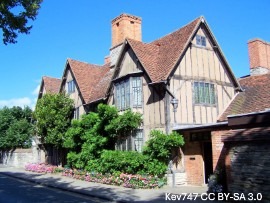
Stratford-upon-Avon home of Shakespeare's daughter is 'At Risk'
Lady Grange’s House repaired on St Kilda
.jpg)
National Trust for Scotland repairs stone cleit with link to famous island resident
Griff Rhys Jones on BBC Radio 4 Today programme
,_Green_Lane,_Derby.jpg)
The Victorian Society’s President unveiled its latest Top Ten Endangered Buildings 2026.
Need a MATE? Book your place now.
IHBC offers free webinars on applying for IHBC accreditation (Full & Associate).
UK Stained Glass Repository finds windows new homes
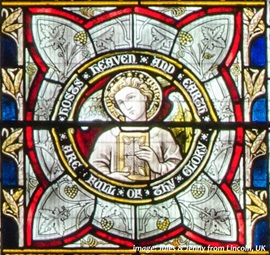
How are stained glass windows are rescued, stored and repurposed?
APPGEBE report sets high aims for quality
'Government must not sacrifice quality in drive to build 1.5m homes'
New measures protect Historic Shipwrecks from heritage crime

Underwater cultural heritage benefits from new HE guidance
How could the City of London skyline look in 6 years' time?

Visualisation shows approved planning applications as completed buildings
National Trust for Scotland calls for VAT cuts
Heritage neglect is encouraged by current policies
IHBC's 'Context' Issue 186 features Industrial Heritage
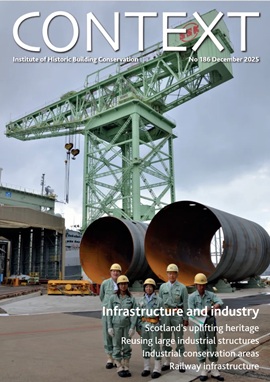
IHBC's members' journal reports on the challenges of conserving infrastructure
Book now for IHBC Annual School 2026
IHBC Annual School is taking place 18-20 June 2026 in Newcastle
RICHeS Research Infrastructure offers ‘Full Access Fund Call’
RICHeS offers a ‘Help’ webinar on 11 March
Latest IHBC Issue of Context features Roofing
Articles range from slate to pitched roofs, and carbon impact to solar generation to roofscapes
Three reasons not to demolish Edinburgh’s Argyle House

Should 'Edinburgh's ugliest building' be saved?
IHBC’s 2025 Parliamentary Briefing...from Crafts in Crisis to Rubbish Retrofit
IHBC launches research-led ‘5 Commitments to Help Heritage Skills in Conservation’
How RDSAP 10.2 impacts EPC assessments in traditional buildings

Energy performance certificates (EPCs) tell us how energy efficient our buildings are, but the way these certificates are generated has changed.